Emerald Boost™ is a concentrated lawn biostimulant designed to support the foundation of turf health: the roots and the soil. It complements your existing lawn‑care program by improving nutrient efficiency, supporting natural plant processes, and helping create deeper, richer color without forcing excessive top growth.
⭐ Why Your Lawn Needs More Than Fertilizer
Most homeowners chase green color by applying more nitrogen. But the real magic of a beautiful lawn happens below the surface. Healthy turf depends on:
🌱 Strong roots
🪨 Balanced soil
💧 Proper moisture movement
⚡ Efficient nutrient use
🌤️ A stable growing environment
Emerald Boost™ supports that system — the part you don’t see but absolutely rely on.
🧪 What Is Emerald Boost™?
Emerald Boost™ is an 8 fl oz concentrated biostimulant formulated to complement fertilizer, mowing, watering, and soil management.
Mixing Ratio:
One bottle makes up to 4 gallons of spray solution. Apply evenly using a pump, backpack, or battery sprayer. Always follow the product label.
🔬 What’s Inside Emerald Boost™ (and Why It Matters)
🌿 Kelp
Supports natural plant processes and overall vigor.
⚡ Fulvic Components
Enhance nutrient availability and movement within the plant.
🧬 Amino Acids
Provide building blocks for growth and stress tolerance.
🌵 Yucca
Helps water penetrate soil more effectively.
🟩 Chelated Iron
Contributes to deeper natural color without forcing excessive growth.
📊 Biostimulant vs Fertilizer
Biostimulant
Fertilizer
Supports soil & root processes
Provides essential nutrients
Improves long-term turf resilience
Drives immediate top growth
Complements a full lawn program
Essential but incomplete alone
🌱 Why Root Health Matters
Your lawn faces heat, drought, heavy rain, foot traffic, mowing stress, compaction, insects, and disease. A strong root system is what allows turf to survive and recover.
A beautiful lawn isn’t built from the top down — it’s built from the ground up.
🧰 How to Apply Emerald Boost™
🧼 Start with a clean sprayer
💧 Add water first
🧪 Add Emerald Boost™
💧 Add remaining water
🔄 Agitate gently
🚶 Apply evenly
🔁 Re‑agitate occasionally
🎯 Sprayer Calibration
Even coverage creates predictable results.
Spray a measured area using plain water, measure how much was used, and you’ll know your sprayer’s output per 1,000 sq ft.
📅 When to Apply
🔥 Warm‑season grasses: late spring through summer
🍂 Cool‑season grasses: spring and fall
Consistency matters more than frequency.
🌾 Grass Types That Benefit
🌿 Bermuda
🌱 Zoysia
🌴 St. Augustine
🍃 Fescue
🔍 What Results to Expect
Supports:
🌱 Root development
🪨 Soil condition
🌿 Turf density
⚡ Nutrient efficiency
🔄 Recovery
💪 Overall vigor
Cannot fix alone:
🧱 Severe compaction
🚫 Poor irrigation
🌑 Lack of sunlight
🐛 Insect damage
🦠 Active disease
✂️ Incorrect mowing
⚠️ Major nutrient deficiencies
📸 Tracking Your Results
Take photos before your first application, from the same angle, at the same time of day. Pull a soil plug occasionally to inspect root development — the real story is underground.
🟩 Emerald Boost™ + Bermuda Grass
Bermuda responds extremely well to frequent mowing, proper irrigation, balanced fertility, soil management, and root‑zone support. Emerald Boost™ fits naturally into a Bermuda program focused on density, color, and recovery.
🌱 Ready to support stronger roots, healthier soil, and a more resilient lawn?
Try LandscapeMarks™ Emerald Boost™ lawn biostimulant concentrate as part of your complete lawn-care program.
A soil test reveals pH, nutrient levels, and hidden limitations. This prevents wasted money and misdiagnosed problems.
💧 Watering Still Matters
No biostimulant replaces proper irrigation. Water deeply, not daily.
✂️ Mowing Still Matters
Sharp blades. Correct height. Consistent frequency. Avoid removing more than one‑third of the blade.
🧱 Emerald Boost™ Isn’t a Shortcut — It’s a System
It’s not fertilizer, herbicide, insecticide, fungicide, or a cure for poor mowing or watering. It’s a support product for homeowners who want a complete lawn‑care strategy.
🏡 Who Emerald Boost™ Is For
🏠 DIY homeowners
🎥 Reel‑mowing enthusiasts
🔥 Bermuda fanatics
📚 Lawn‑care learners
🔬 Anyone wanting deeper turf understanding
💡 Anyone tired of “just throw fertilizer at it”
❓ Frequently Asked Questions
Is it a fertilizer?
No — it complements fertilizer.
How much water do I mix with it?
Up to 4 gallons per bottle.
Will it make my lawn green?
It contains iron, but the goal is overall turf quality.
Can it fix a damaged lawn?
Only if the underlying issue is addressed.
Do I need professional equipment?
No — any calibrated sprayer works.
🛒 Ready to Build Your Lawn From the Ground Up?
LandscapeMarks™ Emerald Boost™ Lawn Biostimulant Concentrate
Support the roots. Support the soil. Build a better lawn.
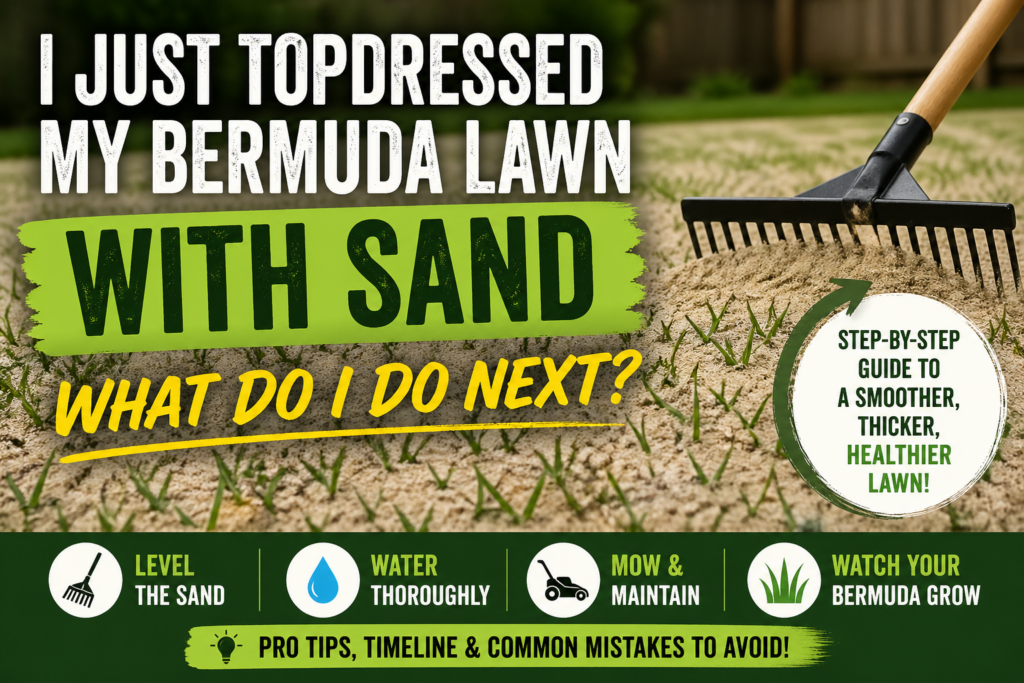
If you just finished topdressing your Bermuda lawn and stepped back to admire your work, you may have had a moment of panic.
Instead of seeing lush green grass, your yard probably looks like a beach.
Sand everywhere.
Grass partially buried.
Uneven patches where the sand piled up.
Maybe you’re wondering:
“Did I just ruin my lawn?”
The good news is — you did not ruin anything.
In fact, if done properly, topdressing with sand is one of the best things you can do for a Bermuda lawn.
Golf courses do it. Athletic fields do it. Professional turf managers rely on it.
But the key to success is not just spreading the sand. It is what you do next that determines how fast your lawn recovers and how good it looks by summer.
Why Sand Topdressing Is So Powerful for Bermuda Grass
Bermuda grass is a spreading grass. It grows using horizontal stems called stolons and rhizomes.
These runners allow Bermuda to grow through sand layers extremely well.
Unlike some grasses that struggle when partially buried, Bermuda can thrive after topdressing because sand helps:
Improve drainage
Reduce soil compaction
Level uneven areas
Encourage lateral spreading
Create a smoother mowing surface
This is why golf courses and athletic fields frequently use sand as part of their turf maintenance programs.
What Your Lawn Should Look Like After Topdressing
Right after topdressing, your lawn may look rough. That is completely normal.
You may see:
Grass blades sticking through sand
Bermuda runners laying across the surface
Some areas partially buried
Light and dark patches across the yard
Uneven sandy spots where the sand settled
The goal is not to completely bury the grass. The goal is to work sand down into the canopy and low areas so the Bermuda can grow through it.
If you can still see some green, runners, or blades sticking through the sand, that is usually a good sign.
Step 1: Drag, Brush, or Level the Sand
The first thing to do after spreading sand is to even it out across the lawn.
Sand can collect in piles, especially in low spots. If those piles are too deep, they can slow recovery or smother parts of the grass.
You can level the sand using:
A lawn leveling rake
A landscape rake
A push broom
A drag mat
A section of chain-link fence
The goal is simple:
Spread the sand evenly and remove any heavy piles sitting on top of the grass.
You do not need perfection on day one. You just want to make sure the sand is not too thick in one area and too thin in another.
Step 2: Water the Lawn Immediately
After the sand is leveled, water the lawn thoroughly.
Watering helps the sand settle down into the grass canopy and soil surface.
Watering also helps:
Reduce stress on the Bermuda
Wash sand off the grass blades
Settle sand into low spots
Encourage runners to grow through the sand
You do not need to flood the yard. Just give it a good, deep watering so the sand begins settling into place.
Step 3: Do Not Panic During the Ugly Phase
After topdressing, your lawn may look worse before it looks better.
This is what I call the ugly phase.
During this stage, your yard may look sandy, uneven, pale, or stressed.
That does not mean the lawn is ruined. It means the Bermuda is adjusting and preparing to grow through the sand layer.
Bermuda grass is aggressive when it has heat, sunlight, water, and nutrients. Once it starts pushing new growth, it can recover quickly.
Step 4: Resume Mowing Sooner Than You Think
One of the biggest mistakes homeowners make after topdressing is waiting too long to mow.
Many people think they need to leave the lawn alone for weeks. But Bermuda grass responds well to frequent mowing, especially during active growth.
Once the grass begins standing back up and the sand has settled, you can resume mowing.
Mowing helps:
Encourage lateral growth
Prevent runners from growing straight up
Keep the lawn even
Train the Bermuda to spread sideways
If you use a reel mower, make sure there are no large piles of sand sitting on the surface. Sand can dull blades, so it is important to brush or water the sand down before mowing.
Step 5: Keep the Lawn Moist, Not Soaked
Water is important after topdressing, but more water is not always better.
Your goal is to keep the Bermuda actively growing without creating muddy or washed-out areas.
Too much water can:
Move sand away from high spots
Create puddles in low spots
Cause uneven settling
Make the lawn too soft to mow properly
A good rule is to water enough to keep the soil lightly moist while the Bermuda recovers.
As the grass starts growing through the sand, you can slowly return to your normal watering schedule.
Step 6: Fertilize to Push Bermuda Recovery
Topdressing is a great time to encourage new Bermuda growth.
Once the sand has settled and the lawn is actively growing, fertilizer can help the grass recover faster.
Bermuda grass loves nitrogen during the growing season. Nitrogen helps promote:
Fast recovery
Dark green color
Thicker turf
More aggressive spreading
Do not overdo it. The goal is to feed the lawn enough to encourage growth, not force weak, excessive top growth.
A balanced approach with watering, mowing, and fertilizer is what brings the lawn back strong.
Step 7: Watch for Runners Growing Through the Sand
One of the most exciting things after topdressing Bermuda is seeing new runners move across the sand.
At first, you may see long Bermuda runners laying on top of the sandy surface.
That is normal.
Those runners are how Bermuda repairs itself and spreads into thin areas.
Over time, they will root down, send up new shoots, and help cover the sand.
This is why Bermuda is such a good grass for topdressing and leveling projects.
Step 8: Do Not Add Too Much More Sand Too Soon
After the first topdressing, you may notice low spots that still need work.
That is normal.
Lawn leveling is usually not a one-time project.
But avoid the temptation to dump more sand everywhere right away.
Give the Bermuda time to recover first.
If small low spots remain, you can lightly touch them up later with thin layers of sand.
The key is gradual improvement.
It is better to apply multiple light layers over time than one heavy layer that smothers the grass.
Step 9: Expect Recovery to Take a Few Weeks
Recovery time depends on weather, watering, mowing, fertilizer, and how much sand was applied.
During warm growing conditions, Bermuda can begin pushing through sand fairly quickly.
You may notice improvement within a week or two, with bigger visual changes over several weeks.
If the lawn still looks sandy after a few days, do not panic.
That is part of the process.
As long as the Bermuda is alive and growing, it will continue filling in.
Common Mistakes After Topdressing Bermuda Grass
Mistake 1: Applying Too Much Sand
Too much sand can bury the grass and slow recovery.
Thin layers are safer and more effective.
Mistake 2: Not Watering Enough
If the sand stays dry and loose, it may sit on top of the canopy instead of settling into the lawn.
Mistake 3: Waiting Too Long to Mow
Bermuda needs mowing to stay dense and spread sideways.
Mistake 4: Overwatering
Too much water can wash sand around and create uneven areas.
Mistake 5: Expecting Perfection Immediately
Topdressing is part of a long-term lawn improvement process. The lawn may not look perfect the next day, and that is okay.
Should You Aerate Before Topdressing?
If you aerated before topdressing, that is a great combination.
Core aeration opens the soil, reduces compaction, and allows sand to settle into the holes.
This can help improve the soil profile over time.
However, even if you did not aerate, topdressing can still help smooth and improve the lawn surface.
Should You Use Masonry Sand, Play Sand, or Topdressing Sand?
For Bermuda lawn leveling, many homeowners use clean masonry sand or leveling sand.
The most important thing is that the sand is clean and free of rocks, debris, clay clumps, or weed seeds.
Avoid sand that is too chunky or full of large particles, because it can make mowing rough and uneven.
Clean sand spreads better, levels easier, and works into the turf canopy more smoothly.
When Will My Lawn Turn Green Again?
If your Bermuda was actively growing before topdressing, it should begin recovering as long as temperatures are warm and the lawn receives proper water and nutrients.
The lawn may look sandy for a while, but green growth should gradually return as the Bermuda pushes through the sand.
The more active the Bermuda is, the faster it will recover.
That is why topdressing is best done during the growing season when the grass is strong enough to heal and spread.
Can I Spray Liquid Fertilizer After Topdressing?
Yes, liquid fertilizer can be useful after topdressing if the Bermuda is actively growing.
Liquid feeding can help push quick green-up and recovery, especially when paired with proper watering.
Just avoid applying too much nitrogen at once.
More is not always better. A steady feeding approach is safer than trying to force the lawn too hard.
Can I Put Humic Acid Down After Topdressing?
Humic acid can be applied after topdressing and may help support soil activity and nutrient availability.
It will not magically level the lawn or replace fertilizer, but it can be part of a good recovery program.
If you already planned to use humic acid, applying it after watering in the sand can be a good option.
Can I Mow with Sand Still Showing?
Yes, but be careful.
You can mow once the sand has settled and the grass is standing back up.
If large amounts of loose sand are still sitting on top, brush it in or water it down first.
Sand can dull mower blades, especially reel mower blades, so you want as much sand worked down into the canopy as possible before mowing.
How to Know Your Lawn Is Recovering
Good signs after topdressing include:
Green blades pushing through the sand
Bermuda runners spreading across bare spots
Sand settling into low areas
The lawn becoming smoother after mowing
New shoots appearing in thin areas
If you see these signs, your lawn is doing what it is supposed to do.
The Long-Term Benefits of Sand Topdressing
Topdressing is not just about making the lawn look better right now.
It is about improving the lawn over time.
With repeated light topdressing, Bermuda lawns can become:
Smoother
Thicker
Easier to mow
Better draining
More even in color and growth
A smoother lawn also reduces scalping when mowing low.
That is especially important if you are using a reel mower and trying to create that golf-course-style Bermuda look.
Final Thoughts: Trust the Process
If your Bermuda lawn is covered in sand after topdressing, do not panic.
That sandy phase is part of the process.
The most important things to do next are:
Level the sand evenly
Water it in
Keep the lawn moist but not soaked
Resume mowing once the grass stands back up
Fertilize during active growth
Give the Bermuda time to spread
What looks like a sandy mess today can become a smoother, thicker, healthier Bermuda lawn over the next few weeks.
Topdressing is one of those lawn projects where the results are not always instant, but they are worth it.
Be patient, keep mowing, keep watering correctly, and let the Bermuda do what Bermuda does best:
Spread, recover, and turn that sand-covered yard back into a thick green carpet.