LANDSCAPEMARKS™ / EQUIPMENT SPOTLIGHT
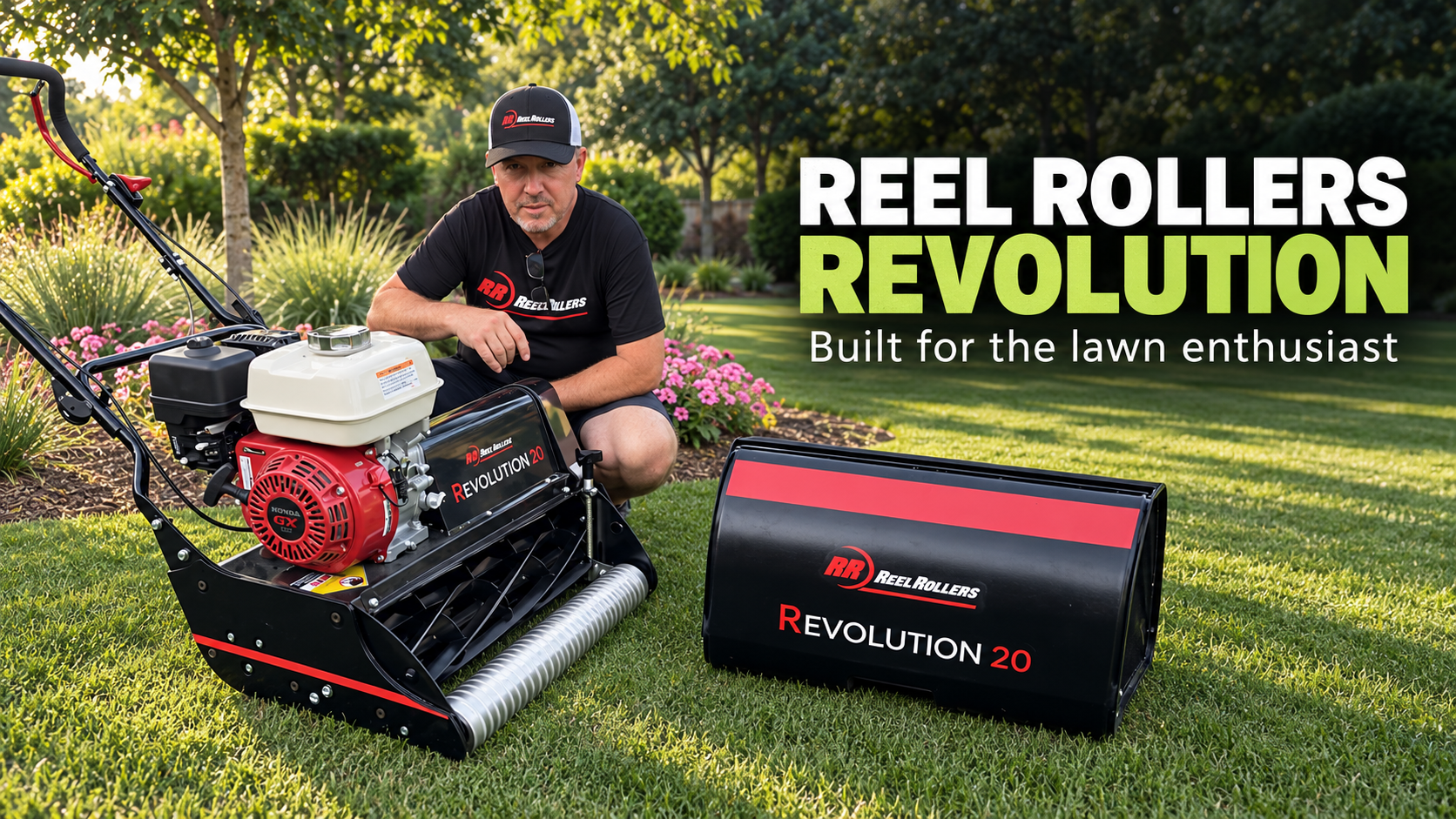
An in-depth look at the design choices behind the Revolution 20 and 26, from independent controls and a grounded cut to easier maintenance and everyday usability. ▶ Watch my Revolution playlist
Why It Matters ·
Controls ·
Cutting System ·
Reel Choice ·
Turf Setup ·
Tradeoffs ·
FAQs
- Independent Drive: Move under power with the reel disengaged
- Relief-Ground Reel: Backlap access without chain removal
- Grounded Design: Heavy grooved front roller and rear drum
- Two Widths: 20-inch and 26-inch configurations
The first pass with a new reel mower is exciting. The real test comes afterward, when you need to cross the driveway, turn at the end of a stripe, empty the catcher, or bring the cutting edge back into adjustment. Those everyday moments tell you whether a machine was designed around the way people actually mow. The Reel Rollers Revolution is interesting because its team paid attention to those moments, not just the look of the lawn after one perfect pass.
A crisp, low cut is only the beginning of the lawn enthusiast’s wish list. We also want precise control, a mower that stays steady on real residential turf, straightforward maintenance, a catcher that does its job, and a team that can help when a part or an answer is needed. Reel Rollers says it spent more than two years developing the Revolution from its own experience and customer feedback, in partnership with Masport. The result is a thoughtful combination of features that address the entire mowing experience.
At LandscapeMarks™, I spend a lot of time working with Bermuda grass, refining mowing height, leveling the surface, and deciding how to handle clippings. I use a McLane GreensKeeper, and the Revolution 20 has become part of my lawn-care content and equipment lineup. That perspective makes me especially interested in how a reel mower feels to own over a full growing season. Here is a closer look at what Reel Rollers built, why the design choices matter, and how to choose the right Revolution for your lawn.
Start With the Actual Wish List
Ask a group of reel-mowing enthusiasts what they want, and you will hear both ambitious and practical answers. They want the crisp look of close-cut turf, clean edges, and stripes that show across the lawn. They also want to start the mower, move between mowing areas, dial in the cut, finish the job, and put the mower away without wrestling with it. Those goals are connected. A technically capable reel that is awkward to operate can make a desirable mowing height difficult to maintain throughout a growing season.
Many residential lawns are not miniature golf greens. They have gates, landscape beds, transitions to concrete, slightly uneven ground, awkward turns, and stretches where a mower needs to travel without cutting. A homeowner may need to mow twice a week during active growth, clean out the catcher, deal with sand after topdressing, and fit equipment into a crowded garage. The best design choices recognize that context. A 20-inch mower can suit tighter residential spaces; a 26-inch machine can cover a wider path where the layout allows. Reel Rollers offers both widths with six- and ten-blade configurations. Reel Rollers positions the Revolution as a commercial-built machine developed for residential lawn enthusiasts. Its combination of substantial hardware and homeowner-focused details explains that positioning.
I like to turn the wish list into a series of questions. Can I propel the mower without running the cutting reel? Can I set my speed and keep control when approaching an edge? Can I check the reel-to-bedknife relationship without dismantling half the drivetrain? Will the front of the machine track across my actual yard? Can I get a replacement part and understand the instructions? The Revolution answers those questions with a coordinated set of features. Some exist on other mowers, too. What stands out here is the way Reel Rollers brought them together around the needs of people who mow short turf regularly.
Who Built the Revolution, and Why the Partnership Matters
Reel Rollers sells and services reel mowers and parts from multiple brands. That position gives a team a useful perspective: the customer does not call only to praise a perfect cut. Owners call when a belt needs attention, an adjustment seems confusing, a cutting unit needs grinding, or a replacement component is hard to source. Reel Rollers says it used that accumulated feedback as a design input and partnered with Masport, a longtime reel mower maker, in developing the Revolution. The 26-inch version came first in its account; the 20-inch version translates the concept to a smaller footprint.
The engineering story becomes clearer when you follow the decisions in sequence: separate propulsion from reel engagement; put a relief grind on the reel at the factory; make backlapping accessible at the end of the reel; use familiar adjustment hardware; fit a heavy grooved front roller; use a split rear drum; include a practical catcher; and make parts information accessible. You can debate which choice matters most, but they all speak to repeated homeowner use.
Reel Rollers presents the Revolution as a project shaped by its customers and developed with Masport. That collaboration matters: a team immersed in reel mower ownership identified the problems worth solving, while an established mower manufacturer helped turn that wish list into a working machine. The result is best understood as a complete design, with each decision supporting the next.
The Headline Feature: Move the Mower Without Spinning the Reel
The feature I would show first to anyone evaluating the Revolution is the separation between ground propulsion and reel engagement. On this machine, the operator can engage the drive to move forward while leaving the cutting reel disengaged. Reel Rollers also lists independent controls for ground speed and the cutting reel at the handlebars. If you have spent time moving a reel mower from one area of a property to another, the appeal is immediate.
Picture the first minute of a normal mow. You come out of the garage, travel across a paved section, round a corner, and approach the grass. You may need to reposition the machine before taking the first full pass. With independent propulsion, you can make that trip under power without asking the reel to cut anything. Then, once you are on the turf and ready for a deliberate pass, you engage the cutting unit. The same choice helps when you need to cross a walkway, navigate between lawn sections, or bring the mower back for cleaning. The manual and the terrain still govern safe operation, and Reel Rollers advises low speed and a slight tilt to keep the grooved roller off hard surfaces during transport.
Why does that matter beyond convenience? An engaged reel can strike unwanted debris and add unnecessary reel-to-bedknife contact when you are simply moving the machine. Reel Rollers argues that separating these functions reduces avoidable wear and the risk of damage. The practical benefit I can confidently describe is control: the operator chooses when the mower travels and when it cuts. Wear savings will depend on adjustment, surface conditions, maintenance, and actual use.
This design also changes the feel of turning at the end of a row. Instead of accepting an all-or-nothing relationship between forward motion and cutting, you have more choices when lining up the next stripe or crossing an area you do not want to cut. It rewards a calm mowing rhythm: finish the pass, clear the cutting reel when appropriate, reposition, and begin the next run. For owners who enjoy precision, that is a meaningful refinement.
Control is More Than Engine Horsepower
The Revolution 20 and Revolution 26 are listed with a Honda GX160 engine rated by Reel Rollers at 5.5 horsepower. Both use a chain-driven arrangement to deliver power to the cutting reel and rear drum. A strong engine gives the machine capacity, but I would not judge a reel mower by horsepower alone. On fine turf, the ability to manage how the machine moves often matters more to the finished surface than a spec-sheet number.
Reel Rollers lists a ground-speed range of zero to 2.75 miles per hour and describes its clutch as allowing independent control of ground speed and reel engagement. That upper number is not a target pace for every cut. The best speed depends on turf density, growth rate, chosen height, surface smoothness, and how cleanly the reel presents the grass to the bedknife. The company itself says faster ground speed is not necessarily better. On thick Bermuda, slowing down and watching the finish may be the right choice. On open, consistently maintained turf, an operator may settle into a faster rhythm.
This is the sort of engineering decision that makes a homeowner machine feel thoughtful. It does not force every operator, grass type, and mowing day into one pace. Think about the difference between an easy midsummer maintenance cut and a recovery cut after a week of heavy rain. The grass presents differently. Your line of sight and the catcher fill differently. Being able to control travel while separately deciding when the reel cuts gives you more ways to adapt without changing the entire setup.
Allow time to learn the controls. Get familiar with the controls on level ground, start conservatively, and use the manufacturer’s instructions. Powerful drive and a heavy machine deserve respect near beds, curbs, slopes, and people. The point of adjustable control is to make the mower easier to guide, not to substitute for attention.
The Cutting Heart: Reel, Bedknife, and the Quality of the Relationship
A reel mower’s cut comes from the rotating reel passing the stationary bedknife. When the geometry and adjustment are right, that combination can trim short turf cleanly and evenly. When the reel is dull, the bedknife is damaged, or the relationship between the two is wrong, no dramatic paint scheme or large engine will rescue the finish. This is why the Revolution’s cutting unit deserves more attention than a simple blade count.
On the 20-inch six-blade model, Reel Rollers lists a 20.5-inch relief-ground reel made with heat-treated steel blades and an adjustable reel-to-bedknife setup. The 26-inch six-blade version lists a 26.5-inch reel. Both have a published cutting-height adjustment range of 0.25 to 1.50 inches. Those measurements describe available settings; they do not promise that a lawn will look good at every setting without adequate turf density, leveling, mowing frequency, and suitable reel selection.
One of the manufacturer’s more interesting design descriptions concerns the bedknife. Reel Rollers describes a curved bottom intended to give clearance at low heights, a horizontal cutting face, and Allen-head bedknife screws chosen for serviceability. Those are details a casual shopper may never notice in a listing photo. An enthusiast who has fought damaged screw heads or watched a low bedknife catch an uneven patch will see why they matter. The benefits should still be evaluated on the owner’s specific surface. A curved profile cannot erase a high spot, and even a well-designed cutting unit needs adjustment and periodic sharpening.
I also appreciate the approach to the reel-to-bedknife adjustment. The manufacturer points to two accessible half-inch bolts for the job. That does not eliminate the need to learn the proper contact and test method. It does lower the barrier to checking and correcting a machine you own. Good equipment invites the owner to maintain its cutting quality; it does not hide the critical adjustment behind a puzzle.
Factory Relief Grinding: An Enthusiast Feature With Everyday Value
A relief-ground reel has material removed behind the blade’s cutting edge, leaving a narrower land at the point that works against the bedknife. The Revolution’s reel comes relief-ground from the factory, according to Reel Rollers. That is not merely a line item to impress equipment collectors. It affects how practical routine backlapping can be for an owner.
Backlapping uses an abrasive compound as the reel turns backward against the bedknife. Done correctly and when appropriate, it can help restore the contact edge between professional grinds. It cannot repair a bent blade, a badly worn bedknife, or serious damage. It also does not replace the need to keep abrasive residue out of the final mowing cut. Knowing when to backlap and when to seek professional service helps protect the cutting unit.
The Revolution addresses a familiar friction point: access. Reel Rollers lists a half-inch bolt at the end of the reel for backlapping with a common socket and says the chains do not need to be removed. That means the owner is not beginning routine maintenance with a drivetrain teardown or searching for a special adapter. The brand recommends backlapping one or two times during a growing season and describes professional grinding roughly every three to four years under its expected use. Treat that as its guidance, not a universal service interval. A sandy lawn, debris strike, frequent low mowing, or heavy use may call for a different schedule.
This has particular resonance for a homeowner who topdresses. Sand can improve a lawn’s smoothness over time, yet loose grit where the cutting unit works also creates a reason to pay attention to sharpness and cleanliness. Do not mow through loose piles of sand and assume any reel will come away unaffected. Let materials settle or work them into the canopy as appropriate, inspect the cutting unit, and follow the mower’s service instructions. The fact that routine edge maintenance is approachable makes that stewardship more realistic.
The larger lesson is simple. A machine is easier to keep cutting well when maintenance was considered before the first sale. Factory relief grinding and backlap access are a good example of design looking beyond the showroom. They support the owner at month six, year two, and every growing season after that.
Six Blades or Ten? Choose by Your Mowing Routine
It is tempting to treat blade count like a simple ranking: ten must be better than six. Reel Rollers explicitly pushes back on that assumption. It recommends the six-blade Revolution for most customers, with an ideal working range around one-half to one inch. It points the ten-blade option toward owners maintaining turf below one-half inch and mowing daily or every other day. The company explains that clip frequency depends on the combination of reel blade count, reel speed, and travel speed. Blade count by itself does not tell the whole story.
Note: A higher blade count does not make a once-a-week schedule work magically at putting-green height.
The distinction matters in a place like northern Alabama. Bermuda can grow rapidly in warm weather. A lawn that is maintained consistently at a moderate low height asks something different from the mower than a lawn kept at one-quarter inch with frequent cuts, aggressive leveling, and careful nutrition. If you choose a ten-blade reel for a very low target, the purchase is also a commitment to the schedule that target requires. Missing several cuts can leave you trying to remove too much material at once.
Likewise, buying the six-blade model is not settling for an inferior cut. It can be the better match for a lawn kept at the height and frequency the manufacturer describes. Before ordering, write down the height you actually keep through the hottest and busiest months, not just the height you hope to photograph during a perfect week. Then consider how often you will mow and how level the yard is. That is a more reliable purchase method than choosing the reel with the biggest number.
I would also distinguish the cutting-height adjustment range from the suggested operating range for each reel. A Revolution may adjust down to 0.25 inch, but Reel Rollers says the six-blade reel is best around 0.5 to 1 inch and points ultra-low users to the ten-blade configuration. If your Bermuda goal is a quarter-inch fairway look, plan around that distinction and the demanding preparation such a height requires. Ask Reel Rollers to confirm the current configuration and recommendation for your turf before buying.
A Heavy Grooved Front Roller for Residential Turf
The front roller is easy to overlook until a mower encounters a slight rise, a shallow depression, or a patch where grass density changes. It helps determine how the machine rides over the surface and how consistently the reel follows the turf. The Revolution 20 is listed with a three-inch grooved front roller weighing 15 pounds. The Revolution 26 lists a 17-pound roller. Reel Rollers says the front roller and the machine’s overall balance were chosen to keep the mower planted and reduce bounce.
That idea will make sense to anyone who has chased a fairway-style look on a yard that is not perfectly planar. A light front end can react differently as the mower enters a thicker patch or crosses a mild contour. A substantial roller can help steady the cutting unit, provided the surface is suitable and the machine is correctly set. But mass is not a substitute for leveling. A mower still follows the geometry of the ground underneath it. Severe undulations, sprinkler heads, exposed roots, and abrupt high spots can cause scalping, missed areas, or an uneven appearance no matter how impressive the roller is.
Grooves introduce another practical consideration. They can suit a well-maintained, short turf surface, but an owner should keep the roller clean and follow the maker’s guidance for transporting it across pavement. Reel Rollers specifically advises a slight tilt when moving the mower on hard surfaces so the grooved roller is kept off the ground. These are not hidden drawbacks; they are part of using the design as intended.
For my kind of lawn work, the more meaningful question is not whether the roller is heavy on paper. It is whether the combination of roller, chassis, rear drum, and cutting-unit placement produces a predictable pass on the turf in front of you. The manufacturer’s specifications show an intentional attempt to solve that whole problem.
The Rear Drum and the Contact Patch Behind the Cut
The Revolution’s rear drive is described as a steel drum with vulcanized rubber tread and a split differential. This is another design choice with several jobs. It moves the mower, supports its weight, and participates in the visual finish that draws many people to reel mowing. A drum distributes contact differently from individual rear wheels, although actual striping and rutting depend on soil moisture, traffic pattern, machine weight, and how the operator turns.
On a closely cut lawn, repeated passes in exactly the same track can become visible. That is true of many types of equipment. Change your mowing direction and take care with sharp turns, especially when the ground is wet or soft. The split differential is listed as part of the rear-drive assembly, and its practical purpose is to accommodate the different wheel or drum speeds needed in a turn. I would still avoid claiming that the mower cannot mark a lawn. A 170-pound machine without its catcher deserves thoughtful handling on a delicate surface.
The rubber tread is also a point of contrast with a bare metal contact surface. Reel Rollers describes it as part of the traction and drive design. The useful owner-level takeaway is that this is a deliberate rear-support system, designed to work with the substantial front roller and the machine’s balance. Reel Rollers additionally highlights a protected side arrangement that helps shield vulnerable hardware. Those features matter most when the mower meets the imperfect edges and transitions found in residential yards.
If stripes are your goal, remember that a reel mower is only one variable. Light direction, grass texture, mowing direction, turf density, and a smooth surface all change what the eye sees. The drum helps create a finish, but it cannot manufacture healthy grass or eliminate the need for a consistent mowing routine.
A Belt-Free Chain Drive Built With Service in Mind
The Revolution uses chains rather than belts to drive its reel and rear drum. Reel Rollers describes heavy-duty chains under a sound-dampening side cover, American standard chain sizes, spring-loaded tensioners, and sealed bearings in its engineering overview. Together, these choices address a recurring owner question: how much routine attention will the drivetrain require?
Chains and belts each have advantages and maintenance needs. A chain drive still needs inspection, cleaning, and the maintenance called for in its instructions. A protective cover is valuable, but it does not make the drivetrain immune to grit, wear, or improper use. What distinguishes this particular package is its apparent focus on accessible, familiar components and tensioning that reduces manual adjustment. Those are meaningful advantages for an owner who does routine checks.
Reel Rollers says it moved to American standard chain sizing so replacement is less dependent on an obscure part, and it highlights spring-loaded tensioners in place of manually adjusted units. That is a very specific response to the enthusiast wish list. Owners do not ask for a feature named “serviceable supply chain.” They ask, “If this wears out in July, can I get back to mowing?” Designing around familiar sizes and available parts is one way to answer them.
The sealed-bearing approach has a similar logic. Reel Rollers says there are no grease zerks on the machine’s bearings. That reduces a routine lubrication task, while leaving the owner responsible for the rest of the mower’s service needs. The Honda engine still needs the correct oil and scheduled maintenance, chains still warrant care, and the cutting unit still needs attention. The value lies in removing routine obstacles while keeping the essential service tasks clear.
Height of Cut: Easy Adjustments and Honest Measurements
The Revolution’s published adjustment range runs from 0.25 to 1.50 inches. Reel Rollers describes a turn-dial adjustment and includes a height-of-cut sticker. This is helpful for owners who change their mowing height as conditions change: lowering carefully during active growth on a smooth surface or raising it when the turf needs relief from heat or stress.
The sticker is a useful reference, but a number on a machine is not necessarily the exact height of the grass in your yard. Real cutting height is affected by setup, the front and rear support points, ground firmness, turf canopy, and whether you measure with an appropriate height-of-cut gauge on a suitable surface. If you are making a major change, do not rely only on the marked setting. Check the mower, make a small adjustment, mow a test area, and examine the turf for scalping, exposed stems, or an uneven finish.
This is especially important with Bermuda. A lawn that looks dense at three-quarters of an inch may show a very different layer of the plant when suddenly taken to a quarter-inch. The machine may physically adjust that low, but the turf needs the density, smoothness, and schedule to support it. Reel mowing rewards gradual planning. Raise your standards for surface preparation as your target height gets lower.
I like that the Revolution makes the adjustment accessible because good lawn care is dynamic. A flexible mower lets the owner respond to actual conditions rather than defend one fixed setting all season. But easy adjustment should lead to better observation, not constant tinkering. Record what works in your yard, mow consistently, and treat the height dial as a tool for measured decisions.
The Catcher is Part of the Design, Not an Afterthought
The 20-inch Revolution includes a 70-liter plastic catcher; the 26-inch version includes an 85-liter catcher. Reel Rollers describes each as approximately three-quarters enclosed and highlights fins on the grass shield that help distribute clippings into the catcher or across the lawn when mowing without it. The catcher is not a small accessory on a mower built for clean residential presentation. It is a practical part of how the mower manages the material it cuts.
Why care about catcher volume and shape? On an actively growing warm-season lawn, stopping every few short passes can break your rhythm. Clippings also affect the look of fresh stripes and can accumulate in visible piles. A generous included catcher gives you the option to remove material when the lawn is producing more than you want to leave behind. Plastic avoids a rust-prone catcher body, although clips, mounting hardware, and normal wear should still be inspected.
A catcher will not solve every mowing problem. Wet turf, extremely heavy removal, or mowing after an extended gap can overwhelm a collection system. Empty it before it becomes overloaded and watch how the mower is performing. If you prefer to leave fine clippings on the lawn, Reel Rollers says the dispersion fins help spread material when the catcher is off. That can be a useful option when the cut is light, the grass is dry, and the result is even. If clippings clump or shade the canopy, change the plan.
The best feature here is choice. A lawn enthusiast may collect during a height reduction and leave light clippings during regular maintenance. The Revolution’s included catcher and shield design support both approaches, subject to the conditions on the day.
Handlebars, Fatigue, and the Realities of Garage Space
Remember: A machine lives in a garage much longer than it lives on the front lawn. The way it folds, moves, and fits at home deserves the same attention as the first-pass photograph.
A mower can have an excellent cutting system and still be tiring to use if its handle height or grip puts the operator in an awkward position. Reel Rollers lists adjustable, cushioned handlebars with a roughly 35- to 41-inch height range. The handles fold for storage; the listed folded height of the 20-inch machine is about 22 inches, with the caveat that you should check the full garage footprint and actual clearance before purchase.
That range is useful because users differ in height, arm position, and preferred leverage. There is no one grip setting that will feel natural to everyone. The ability to adjust the handle allows the owner to find a stance that keeps shoulders relaxed and makes turns more controlled. Cushioned grips may feel better over a long session, though they cannot erase engine vibration or make a heavy machine weightless. Comfort claims should be judged after real mowing, not only a showroom test.
Storage is equally practical. Many homeowners share a garage with tools, a vehicle, fertilizer, a sprayer, or a second mower. Folding handles can turn a frustrating storage problem into an easier one. Measure the floor space as well as the folded height, and think about how you will move the machine in and out without hitting shelves or equipment. A 20-inch Revolution weighs approximately 170 pounds before the catcher, according to the maker; that mass is part of how it rides on turf, but it also matters when you plan ramps, transport, and storage. The 26-inch model is heavier still.
What the 20-Inch and 26-Inch Versions Ask of Your Yard
The 20-inch and 26-inch Revolutions share the central design philosophy, but width is a real decision. The narrower model can be appealing when the yard has gates, tighter borders, small sections, or limited storage. It may take more passes across a wide open lawn, yet those passes can be easier to place precisely. The wider version is attractive when much of the work is on broad, open turf and reducing the number of passes saves meaningful time. Reel Rollers lists six- and ten-blade choices in both widths.
Think beyond the advertised width. Measure your narrowest passage and consider the full physical footprint, including the catcher and any nearby landscape features. Ask whether you routinely mow between beds or around ornamental plantings. Consider your trailer or ramp if you move equipment to another property. A mower that is efficient on the big rectangle may be less convenient in a side yard with frequent turns.
The larger front roller, larger catcher, and greater machine weight on the 26-inch version all make sense alongside its wider reel. Those are not free benefits; the owner has to manage the extra size.
| Specification | Revolution 20 | Revolution 26 |
|---|---|---|
| Weight (w/o catcher) | ~170 lbs | ~200 lbs |
| Weight (w/ catcher) | ~180 lbs | ~215 lbs |
| Front Roller | 15 lbs | 17 lbs |
| Catcher Volume | 70 liters | 85 liters |
I would recommend drawing your usual route before buying. Mark where you turn, where you dump clippings, where you cross pavement, and where a wider machine may be blocked. That simple exercise can reveal more than a comparison of cutting widths alone.
A Machine Designed to be Owned, Not Just Purchased
The support plan is part of the product. Reel Rollers lists a QR code leading to parts, manuals, warranty material, frequently asked questions, and instructional videos. It also sells Revolution parts and describes service offerings for several reel mower brands. For a first-time reel mower owner, access to a sensible how-to video can be the difference between confidently making an adjustment and leaving a poor cut alone for weeks.
The company also lists factory mount points for precise grinding at a local reel mower shop. That is an easy feature to underappreciate until the day the cutting unit needs professional work. A mower that is intended to be sharpened accurately and returned to service over many seasons is a different ownership proposition from a disposable purchase. The availability, cost, and timing of service will still vary by location, so identify a shop or ask Reel Rollers about its current options before it becomes urgent.
The published warranty is one year for noncommercial residential use and 90 days for commercial use on the product pages I reviewed. Read the actual warranty terms for exclusions and procedures. This is equipment with an engine, drivetrain, reel, bedknife, and bearings; no QR code removes the need for preventive care. What a good support system can do is shorten the distance between a question and a useful answer.
The parts strategy reflects another smart idea: build a machine someone can understand. Familiar socket sizes, accessible adjustments, an exposed backlap point, diagrams, and available components can make an enthusiast more capable over time. That is a kind of value that does not appear in a photograph of fresh stripes.
What I Would Evaluate in the First Month of Ownership
If I were setting up a Revolution on a new lawn, I would begin with a baseline. Confirm the correct engine oil and break-in requirements from the current manual; the product listing says the mower ships without oil. Check the assembly, safety controls, catcher fit, reel condition, and recommended adjustment procedure. Walk the lawn for debris and sprinkler heads. Decide on a conservative cutting height for the turf’s current condition, then make a short test pass before committing to the whole property.
During the first several cuts, I would look beyond whether the lawn photographs well. Does the machine track straight on my typical route? How naturally can I regulate travel speed on dense turf? Can I cross a sidewalk with the reel disengaged without awkward handling? Are the clippings reaching the catcher evenly? What happens at the edge of an area I have recently leveled with sand? These observations reveal how the design interacts with my particular lawn.
I would also monitor the turf itself. A clean, even surface after a reel pass is encouraging. Torn tips, repeated missed stalks, scalping on a high spot, or a visible stair-step after adjacent passes deserve diagnosis. The cause may be a dull or misadjusted cutting unit, an inappropriate height, an overly fast pass, uneven terrain, or a mower setup issue. Do not automatically blame or praise the machine for every symptom. Change one variable at a time and follow the manual when inspecting the cutting unit.
After the first few sessions, check the service items at the intervals Reel Rollers and Honda specify. Learn the location of the backlap point and the bedknife adjustment bolts before you urgently need them. When equipment makes ownership approachable, take advantage of it. A little familiarization early tends to pay off during the fast-growing part of the season.
Where the Revolution Fits in a Bermuda Lawn Program
For Bermuda grass, the mower is part of a broader maintenance system. An excellent reel can reveal the rewards of frequent mowing and a level surface, but it will also expose thin turf, sand ridges, irrigation inconsistencies, and missed mowing windows. At low heights, the canopy has less room to hide unevenness. That is one reason I pay as much attention to surface preparation and the mowing schedule as I do to the equipment.
The manufacturer’s six-blade recommendation of roughly one-half to one inch aligns with many homeowners who want a refined, short Bermuda lawn without committing to near-daily ultra-low mowing. A homeowner aiming under one-half inch should seriously consider the ten-blade configuration and the frequency Reel Rollers recommends. If you are aiming for a quarter-inch visual, plan for leveling, turf density, consistent water, careful feeding, and repeated cuts. The blade choice does not create those conditions for you.
On my own projects, I think about how a mower fits alongside other equipment. A larger primary reel mower may handle the main cuts, while a 20-inch machine can be useful where a different width or handling character suits a task. I would not make a universal claim that everyone needs two reel mowers. The right setup depends on the property and the operator. What I value in the Revolution 20 is that it brings independent drive and reel controls, a substantial grooved roller, a serviceable cutting system, and an included catcher into a compact width.
Seasonal judgment still matters. If heat, drought, or a change in turf density calls for a higher cut, adjust the mower and let the grass recover. Having a broad height range makes the Revolution more useful across a real growing season.
Honest Tradeoffs Before You Buy
It is just as useful to know where the Revolution fits best. The Revolution is a substantial, gas-powered reel mower. That can be a good fit for a dedicated homeowner who enjoys close-cut turf and regular equipment maintenance. It may be a poor fit for someone seeking a lightweight mower to lift into a car, a machine for very tall or weedy grass, or a tool for an extremely rough lawn that has not been prepared for reel mowing. Reel Rollers itself says reel mowers perform best on shorter, dense turf and may push over tall grass or weeds instead of cutting them.
The engine needs fuel and service. The mower needs storage space, a safe route between mowing areas, and care around rocks and debris. Height adjustments and backlapping are made easier by the design, but they remain tasks the owner must understand. The included catcher has capacity, but an overgrown lawn can still produce more clippings than is pleasant to collect. A roller and rear drum help the machine ride the turf, but they cannot flatten your yard by themselves.
Budget matters too. Current sale prices and availability change, so check the live product listing for the model you want rather than relying on a figure in a blog post. Factor in the right reel configuration, freight or pickup, oil, a safe ramp or storage plan if needed, maintenance supplies, and future professional grinding. If those costs fit a lawn-care hobby you genuinely enjoy, the features may be worth substantial money to you. If your mowing goal is simply to keep a mixed yard tidy every week or two, a precision reel mower may be the wrong category entirely.
Other mowers offer some of these features, and specifications vary by model. The Revolution’s strength is the complete package: Reel Rollers combined cutting performance, control, practical maintenance, and owner support with residential lawn enthusiasts in mind.
What Makes This Design Feel Different
A good design has an argument running through it. With the Revolution, that argument is that reel mowing should be precise without making ordinary ownership needlessly difficult. It begins before the cut, when you move the machine with the reel disengaged. It continues in the pass, where ground speed, a substantial front roller, and a supportive rear drum help you guide a consistent machine over short turf. It carries into maintenance, where relief grinding, a backlap point, familiar adjustment sizes, and a service-oriented parts strategy make it easier to preserve cut quality.
Those choices answer familiar complaints rather than an imagined spec-sheet contest. Homeowners ask for less awkward transport. They want a steady mower, an easy-to-empty catcher, a handle that fits, and a sensible way to keep the reel sharp. They want parts when something wears and instructions when they are learning. Reel Rollers says those voices shaped the project. The published feature set makes that claim credible, even though it does not prove that every component is unprecedented or that the mower will outperform every rival in every yard.
That is why I see the Revolution as a state-of-the-art choice for a dedicated homeowner. Its best qualities appear in the routine moments: approaching a sidewalk, setting a comfortable pace, keeping the reel sharp, and making the next mow as satisfying as the first.
Questions I Would Ask Before Ordering
First, what is my real mowing height throughout the growing season? If the answer is usually one-half to one inch, the manufacturer’s guidance points toward six blades. If the goal is below one-half inch and the lawn is mowed almost daily, the ten-blade option deserves attention. Ask Reel Rollers to confirm its current advice for your grass, mowing frequency, and model.
Second, what width fits the whole property? A 26-inch cut can reduce passes on open turf, while a 20-inch machine may be easier to thread through tight places. Measure gates, walkways, storage space, and your usual path to the lawn. Include the catcher when you think about maneuvering, and plan for the machine’s weight if you need a ramp.
Third, is the surface ready? Low mowing exposes high spots and thin areas. If you plan to topdress or level, coordinate the timing so loose grit is not pushed through a valuable cutting unit. Start with a height your turf can support and lower cautiously as density and smoothness improve.
Fourth, who will maintain it? Decide whether you are comfortable learning to check reel-to-bedknife adjustment and backlap under the manufacturer’s instructions. Identify a local reel-grinding service or ask the seller about service options. A maintenance-friendly design offers its greatest value when someone actually maintains it.
Finally, what would success look like after a full season? For me, it would be a mower that encourages regular cutting, produces a consistent finish on a prepared surface, does not turn basic maintenance into a major project, and gives me enough control to adapt as the lawn changes. That is a more useful standard than a single photograph from the first weekend.
Frequently Asked Questions
Is the Revolution 20 Only for Very Short Bermuda?
No. Reel Rollers lists a 0.25- to 1.50-inch adjustment range and recommends the six-blade model particularly for a cutting height around 0.5 to 1 inch. The suitable setting also depends on grass type, lawn smoothness, density, and mowing frequency. If your objective is below 0.5 inch, review the ten-blade recommendation and the more demanding schedule that comes with it.
Do Ten Blades Automatically Give a Better Cut?
No. Blade count interacts with reel speed, travel speed, grass height, and mowing frequency. Reel Rollers recommends six blades to most customers. The ten-blade option is aimed at turf kept below 0.5 inch and cut very often. Select the setup that matches your actual routine.
Can the Revolution Travel Without the Reel Cutting?
Yes. Its independently controlled ground propulsion and reel engagement let the mower move under power while the cutting reel is disengaged. Follow the transport guidance and protect the grooved roller on hard surfaces.
Is Backlapping Really Easier?
The manufacturer provides an accessible half-inch bolt at the reel end and says you can backlap without removing chains. That simplifies access, but the process still calls for correct technique, protective precautions, cleaning, and a decision about whether backlapping is appropriate for the cutting unit’s condition.
Is the Grooved Roller Included?
The current product listings show a grooved front roller as included equipment: approximately 15 pounds on the Revolution 20 and 17 pounds on the Revolution 26. Verify current configuration when ordering.
What Does the Mower Weigh?
Reel Rollers lists the Revolution 20 at about 170 pounds without its catcher and 180 pounds with it. It lists the Revolution 26 at about 200 and 215 pounds respectively. Shipping weights are higher because the machine arrives on a pallet. Plan storage and transport accordingly.
Will It Cut Tall Weeds and an Overgrown Lawn?
That is not what this type of mower is optimized to do. Reel Rollers says reel mowers perform best on shorter, dense turf and that tall grass or sporadic weeds may be pushed over. Bring an overgrown lawn back under control with an appropriate plan before expecting a fine reel finish.
Can I Leave the Clippings on the Lawn?
The included catcher lets you collect them; Reel Rollers also describes grass-shield fins intended to spread clippings when the catcher is removed. Whether leaving them works well depends on how much grass you are cutting, how dry it is, and whether clippings disperse evenly rather than clump.
Final Thoughts: An Enthusiast’s Machine Built Around the Entire Experience
The Reel Rollers Revolution is most interesting when you look past the first stripe. The company and its Masport partner brought together a set of features that speaks directly to the lawn enthusiast’s working day: independent ground drive and reel engagement, controllable pace, a factory relief-ground reel, accessible backlapping and bedknife adjustment, a heavy grooved front roller, a treaded rear drum, chain-drive service choices, a useful catcher, adjustable folding handlebars, and a route to parts and instruction. Those details do not take care of the lawn for you. They make it easier to do the careful work that a beautiful, low-cut lawn requires.
I appreciate that the Revolution’s engineering is aimed at repeated use rather than a single spectacular demonstration. Every mower looks its best in perfect conditions. The machine that earns a place in a homeowner’s routine is the one that still makes sense when the grass is growing quickly, the driveway separates two mowing areas, the cutting edge needs attention, and the garage is full. That is the wish list Reel Rollers appears to have taken seriously.
If you are considering one, match the width and reel to your real yard and schedule. Prepare the surface, learn the controls, follow the service guidance, and judge the results over a season. A well-designed mower is a valuable partner in that process. The Revolution gives an enthusiast a lot of thoughtful equipment to work with—and a good reason to enjoy the next pass.
Ready to Take a Closer Look?
Watch my Reel Rollers Revolution videos, then explore the 20-inch and 26-inch models to find the right fit for your lawn and mowing schedule.
▶ Watch the YouTube playlist |
Explore the Revolution models →
When you reach out to the Reel Rollers team, tell them LandscapeMarks™ sent ya!