
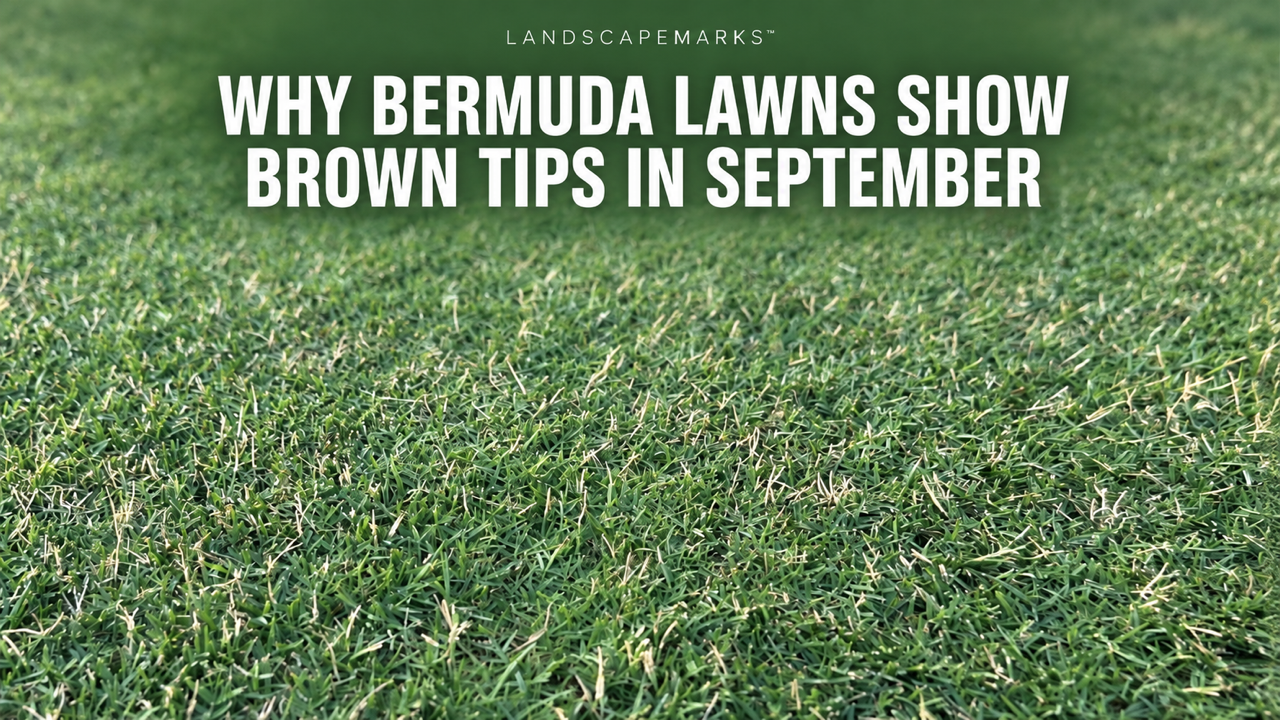
A thick, green Bermuda lawn can look nearly perfect throughout the summer. Then September arrives, you finish mowing, and suddenly hundreds of tan or brown tips seem to appear across the surface.
The lawn may still be dense and green underneath, but those light-colored tips make the entire yard look faded. They are especially noticeable when the sun hits the lawn or when the grass is viewed from a lower angle.
Naturally, the first question is:
What went wrong?
Brown tips can be caused by several things, including a dull mower blade, drought stress, scalping, disease, insects, or an inconsistent mowing schedule. However, when the lawn has been maintained properly and the grass appears healthy near the base, the changing season may be responsible.
September is a transitional month for Bermuda grass. The calendar may still say summer, especially here in the Southeast, but the lawn is already responding to shorter days, cooler nights, changing sunlight, and slower growth.
Sometimes there is nothing you need to spray. There may not be a product that can immediately correct the appearance. The best response may be to continue providing good maintenance and allow the Bermuda to move through its natural seasonal cycle.
Why Brown Tips Become More Noticeable in September
Bermuda grass is a warm-season grass that performs best during long, hot, sunny days. Its most aggressive growth normally occurs during late spring and summer when soil temperatures are warm and daylight is plentiful.
September begins changing that environment.
Even when daytime temperatures remain high, several seasonal changes are taking place:
- The days are becoming shorter.
- The angle and intensity of sunlight are changing.
- Overnight temperatures may begin dropping.
- Morning dew can remain on the grass longer.
- Soil temperatures gradually begin declining.
- Bermuda’s rate of growth and recovery starts slowing.
Bermuda does not normally enter full dormancy during September in Northern Alabama, but it can begin showing signs that the peak growing season is ending.
This transition does not always happen evenly. Some blades may remain completely green while others develop tan tips, older tissue, or seed stalks. Areas that receive less sunlight or experience greater stress may change before the warmest and sunniest sections of the lawn.
The result can be a lawn that looks green from a distance but appears sprinkled with tan material after mowing.
First, Look Closely at the Grass
Before applying fertilizer, iron, fungicide, or another lawn product, pull several blades from different areas and inspect them closely.
The appearance of the individual blades can tell you much more than looking at the entire lawn from a distance.
A clean brown or tan section at the top
If the grass is green and healthy from the base upward but the upper portion is tan, the discolored tissue may be older growth, a spent seed stalk, or tissue responding to seasonal stress.
This does not automatically mean the lawn is dying.
Ragged, shredded, or stringy tips
If the ends look torn, fuzzy, or shredded, inspect your mower.
A dull rotary blade can beat and tear the grass instead of cutting it cleanly. Those damaged ends lose moisture and turn tan or brown, sometimes within hours of mowing.
The same general principle applies to a reel mower. A reel that is dull, improperly adjusted, or making poor contact with the bedknife can leave grass with an uneven or frayed cut.
Alabama Cooperative Extension notes that mower sharpening may be required several times during a growing season, depending on mowing frequency, grass type, and contact with debris. A sharp cutting surface becomes particularly important on Bermuda maintained at a low height.
A straight, clean cut with green tissue below it
A clean cut normally indicates that the mower is doing its job. If the remaining plant is green and the lawn is not thinning, the discoloration may simply be older leaf tissue or seasonal material that has moved above the normal canopy.
Tall, thin, light-colored stems
These may be Bermuda seed stalks rather than ordinary leaf blades.
Seed stalks often stand above the green canopy, making them the first thing the mower touches. After they are cut, the remaining portions can appear tan or white against the darker lawn.
Bermuda may produce seed heads in response to its natural growth cycle, environmental changes, or stress. Their presence does not necessarily mean the lawn has a serious problem.
Could the Mower Be Causing the Brown Tips?
A dull or improperly adjusted mower should always be one of the first things you eliminate.
With a rotary mower, inspect the grass for shredded ends. Check the blade for damage, dull edges, bends, and buildup underneath the deck.
With a reel mower, perform a paper-cut test across multiple areas of the reel. The reel and bedknife should cut paper consistently from one side to the other. A reel can appear sharp but still leave a poor cut if the reel-to-bedknife relationship is not set correctly.
Also consider the amount of grass removed.
Removing too much of the green canopy in a single mowing can expose brown stems, stolons, thatch, and older plant material underneath. This is commonly described as scalping, even when the mower does not physically touch the soil.
Follow the one-third rule whenever possible: avoid removing more than approximately one-third of the grass blade in a single mowing.
That rule becomes even more important in September because Bermuda may not recover as quickly as it did during June, July, or August.
North Carolina State Extension recommends raising Bermuda’s mowing height slightly as fall approaches, with the timing depending on location and climate. For a highly maintained, low-cut lawn, that does not necessarily mean making a dramatic height change. Even a modest increase can leave more green tissue on the plant and reduce the chance of exposing the brown material below.
September Stress Can Show Up After Mowing
Mowing does not always cause the discoloration. Sometimes mowing simply reveals stress that was already present.
A dense canopy can hide tan stems and older growth. Once the upper green portion is removed, that material becomes more visible.
Possible September stressors include:
- Extended dry weather
- Irregular irrigation
- Excessive irrigation
- Compacted soil
- Heavy traffic
- Low mowing
- Rapid changes in temperature
- Reduced sunlight
- Excessive thatch
- Recent herbicide applications
- Heavy fertilizer applications
- Repeated scalping
Look for patterns before selecting a treatment.
Drought stress often appears first in areas near concrete, slopes, compacted sections, or places receiving poor sprinkler coverage. Mower problems usually appear more uniformly or follow the mowing pattern. Disease is more likely to create distinct patches, lesions, thinning, or areas that continue expanding.
Seasonal change can appear as a more general loss of color or scattered tan material throughout an otherwise healthy lawn.
Will Liquid Iron Turn the Brown Tips Green?
No. Iron cannot bring dead or damaged tissue back to life.
A liquid iron application may deepen the color of living green tissue if the lawn is actively growing and the product is appropriate for the grass. That darker background can sometimes reduce the visual contrast of the tan tips, making the overall lawn appear greener.
However, the brown portions themselves will remain brown.
The same rule applies to fertilizer and biostimulants. These products may support living turf when used correctly, but they cannot recolor tissue that has already dried, been torn by a mower, or entered seasonal decline.
The brown material must eventually be removed through mowing, break down naturally, or be replaced by new growth.
This is why spraying more products is not always the answer.
Should You Apply Nitrogen to Force New Growth?
Be careful about trying to force summer-level growth as fall approaches.
During the active growing season, properly timed nitrogen can help Bermuda recover and produce new green tissue. As growth begins slowing, however, the lawn may not respond as quickly or evenly.
Excessive late-season nitrogen can encourage tender growth at the wrong time and may increase management or disease concerns. Fertilizer decisions should be based on your location, soil-test results, recent applications, weather, and the amount of active growth remaining.
If you recently applied nitrogen, avoid stacking another application simply because you see tan tips after mowing.
Give the lawn time to respond. More fertilizer is not automatically a faster or better solution.
Could It Be a Lawn Disease?
Disease should remain on the checklist, but scattered tan tips do not automatically justify applying a fungicide.
Look for additional symptoms such as:
- Circular or irregular patches
- Areas that continue expanding
- Significant thinning
- Spots or lesions along individual blades
- A dark border surrounding a tan lesion
- Cotton-like fungal growth during early morning hours
- Grass that pulls loose from the crown
- Consistently wet areas with poor drainage
If the entire lawn remains dense and green at its base while only the tips or tall stalks are tan, a widespread destructive disease is less likely.
Applying a fungicide without identifying a disease can waste money and may do nothing to improve the lawn. When symptoms are unclear or continue worsening, send samples and photographs to your local Extension office or turf diagnostic laboratory.
When the Best Treatment Is Patience
Lawn enthusiasts are trained to react.
We see a color change and immediately begin thinking about iron, nitrogen, fungicide, insecticide, irrigation adjustments, or another product that promises a quick response.
But Bermuda is a living plant operating on a seasonal schedule.
By September, it is beginning to prepare for a slower period. In Northern Alabama, hot afternoons can make the lawn feel like it should still be growing at full summer speed. Shorter days and cooler nights tell the plant something different.
If you have confirmed that:
- Your mower is cutting cleanly
- You are not removing too much grass
- The lawn is receiving appropriate water
- There are no clear signs of insects or disease
- The base of the plant remains green and healthy
- The lawn is not rapidly thinning
Then the tan tips may not require treatment.
Continue mowing as needed, monitor soil moisture, avoid aggressive renovation work, and allow the lawn to progress naturally.
You may not be able to spray away every seasonal imperfection — and that is perfectly normal.
A Simple September Checklist for Bermuda Lawns
When brown tips appear, work through this checklist before applying anything:
1. Inspect individual blades
Determine whether the ends are cleanly cut, shredded, spotted, or attached to tall seed stalks.
2. Check the mower
Inspect or sharpen rotary blades. For reel mowers, confirm the reel and bedknife cut paper consistently across the entire width.
3. Review your mowing height
Make sure you are not removing too much of the canopy at once. Consider a small seasonal height increase as recovery begins slowing.
4. Check soil moisture
Do not judge moisture by the surface alone. Check the soil several inches down and inspect sprinkler coverage.
5. Look for a pattern
Uniform discoloration, mowing stripes, dry edges, circular patches, and isolated problem areas may point to different causes.
6. Review recent applications
Consider whether fertilizer, herbicide, plant growth regulator, iron, or another lawn product was recently applied.
7. Watch the lawn for several days
If the base remains healthy and the problem does not expand, immediate treatment may be unnecessary.
What Not to Do
Avoid making several corrective applications at the same time.
For example, applying fertilizer, iron, fungicide, and additional irrigation together makes it nearly impossible to determine what was actually happening. It can also create new stress when the lawn was already beginning a normal seasonal transition.
Instead, eliminate the simplest causes first:
- Confirm the quality of cut.
- Confirm the mowing height.
- Confirm soil moisture.
- Inspect for disease or insects.
- Allow time for observation.
Good lawn care is not always about adding something. Sometimes it is about knowing when to step back.
The Bottom Line
Brown tips in a September Bermuda lawn can be frustrating, especially after months of maintaining a deep green, tightly cut surface.
Sometimes the mower is responsible. Sometimes the lawn is dry, stressed, scalped, or affected by disease. Those possibilities should be investigated.
But when the mower is sharp, the watering is correct, the lawn is dense, and the grass remains green near the base, the changing season may be the real explanation.
September Bermuda will not always look exactly like July Bermuda.
Growth is beginning to slow. Older tissue becomes more visible. Seed stalks may stand above the canopy. The lawn’s color and texture may become less consistent as the plant responds to shorter days and cooler nights.
Iron may darken the living tissue, but it will not turn dead tips green. Fertilizer cannot reverse seasonal aging. Fungicide will not correct a problem that is not caused by a fungus.
Sometimes the proper treatment is simply good mowing, appropriate watering, careful observation, and patience.
The goal should not be to force Bermuda to behave like it is midsummer forever. The goal is to guide it through the seasonal transition in the healthiest condition possible so it can rest during winter and return strong next spring.
That is one of the hardest lessons in maintaining a great Bermuda lawn:
Not every color change requires a product, and not every brown tip means something is wrong.
LandscapeMarks™ shares practical lawn-care experiences for DIY homeowners. Always follow product labels and consult your local Extension office when diagnosing persistent turf damage.